SCEGA Permit Requirements in Saudi Arabia
permitsevents
[ October 12, 2026 by events 0 Comments ]

SCEGA Permit Requirements in Saudi Arabia: Common Application Mistakes to Avoid (2026)

Organizing a conference, workshop, professional meeting or exhibition in Saudi Arabia involves more than selecting a venue and inviting attendees. Depending on the event category, organizers may need a SCEGA permit, license or other applicable approval before proceeding.

The Saudi Conventions and Exhibitions General Authority (SCEGA) oversees important aspects of the Kingdom’s business-events sector, including relevant conferences, exhibitions and other professional gatherings.

For event organizers, understanding SCEGA permit requirements in Saudi Arabia is an important part of preparing a successful event.

This 2026 guide explains the practical information organizers should prepare, common application mistakes and how to avoid unnecessary complications.

1. Identify the Correct Event Category

One of the first mistakes organizers make is assuming that every business event follows the same approval process.

A professional conference, training program, workshop, business meeting and exhibition may have different requirements.

Before preparing an application, clearly establish the purpose and structure of the event.

Consider whether your event involves:

  • A professional conference or forum
  • A workshop or training program
  • A business meeting
  • An exhibition or trade event
  • Multiple activities within one event

Selecting the correct category helps organizers understand which requirements may apply.

If you’re uncertain about the appropriate process, Merci Event offers SCEGA Permit Services in Saudi Arabia to assist with event permit applications.

2. Prepare Accurate Event Information

Incomplete or inconsistent information can complicate an event application.

Before starting, organizers should prepare the essential details of their planned event.

These may include:

  • Event name and purpose
  • Organizer details
  • Proposed event dates
  • Venue and location
  • Expected audience
  • Event agenda
  • Speakers or participants
  • Exhibition or workshop activities
  • Other information required for the selected service

The exact documentation depends on the applicable event category and current requirements.

A clear event plan makes it easier to identify missing information before an application is submitted.

3. Confirm Your Venue Early

Venue planning is closely connected to event preparation.

An organizer might select a hotel ballroom, conference center or exhibition venue based on capacity and location without first checking whether it is suitable for the intended event and applicable approval process.

Before finalizing arrangements, consider the venue’s suitability, available facilities, event layout and any relevant regulatory conditions.

Changes to the event location after an application has been submitted may also require additional coordination.

For organizers planning larger business events, Merci Event provides Conference Management Services to support event planning and production.

4. Avoid Last-Minute Application Planning

Another common mistake is leaving permit preparation until shortly before the event.

By that stage, organizers may already have confirmed speakers, suppliers, staging, branding and promotional activities.

If additional information or clarification is required, there may be limited time to respond.

A better approach is to consider the applicable approval requirements during the early planning stages.

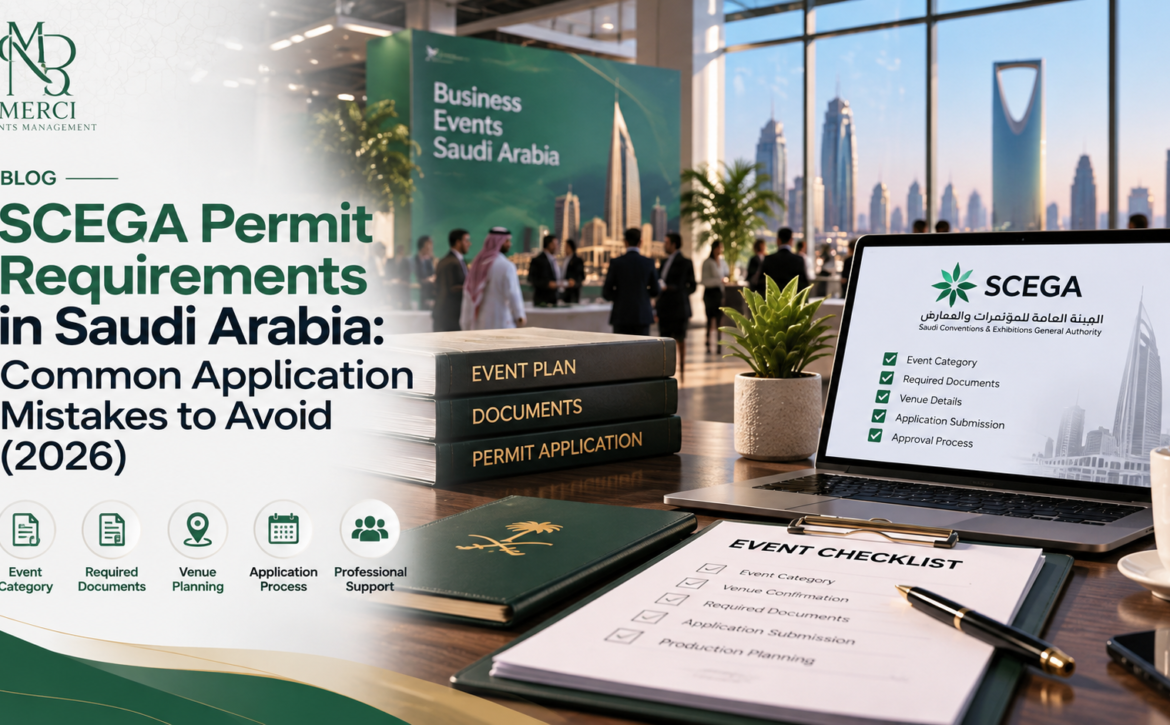
Event concept → Event category → Venue → Documentation → Application → Production planning

Processing times can vary depending on the service and application circumstances.

For further guidance, read our existing article, How Long Does an Event Permit Take in Saudi Arabia? (2026).

5. Check Whether Additional Activities Need Separate Consideration

Some events include more than one activity.

For example, a corporate conference may also feature an exhibition area, professional workshops or an entertainment program.

These activities should be assessed as part of the overall event plan rather than assuming one approval automatically covers everything.

Where entertainment activities are involved, different regulatory requirements may apply.

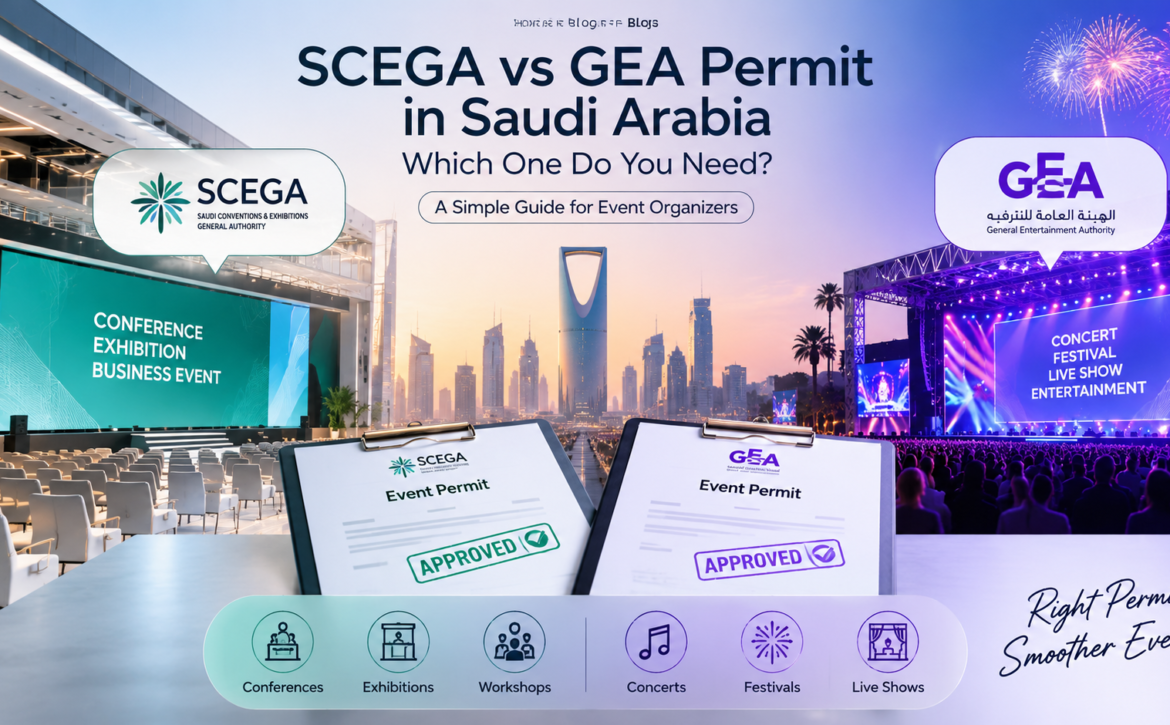
For more information, explore our SCEGA vs GEA Permit in Saudi Arabia: Which One Do You Need? (2026) guide.

Merci Event also provides GEA Permit Application Support for relevant entertainment-event requirements.

6. Keep Event Details Consistent

Consistency is important throughout the application and planning process.

Differences between the proposed event date, venue, organizer information or activities can create confusion and may require clarification.

Before submitting information, review the details carefully.

If important event arrangements change, determine whether the application or approval needs to be updated.

Organizers should also ensure that event promotion follows the applicable approval conditions.

7. Coordinate Permit Planning With Event Production

Permit preparation and event production should not be treated as completely separate activities.

The event format, venue and schedule can influence production requirements such as:

  • Stage design
  • Registration arrangements
  • Exhibition booth layouts
  • LED screen installation
  • Sound systems
  • Lighting
  • Audience seating
  • Technical operations

For example, a conference with presentations and live video may require an LED display setup suited to the venue and audience.

Explore Merci Event’s LED Screen Rental in Saudi Arabia services for event display and production support.

Coordinating these elements early can make the overall event-planning process more efficient.

8. Get Professional Support When Needed

For companies organizing their first conference, workshop or exhibition in Saudi Arabia, understanding the relevant application process can be challenging.

Professional assistance can help organizers review their event information, identify the appropriate application route and prepare for the next steps.

Merci Event supports businesses and event organizers with SCEGA permit application assistance alongside conference, exhibition and event-production services.

For a step-by-step introduction, read our How to Apply for a SCEGA Permit in Saudi Arabia (2026) guide.

Final Thoughts

Preparing for a SCEGA permit in Saudi Arabia starts with understanding the event itself.

Identifying the correct category, confirming the venue, preparing accurate information and checking requirements early can help organizers avoid common planning mistakes.

Because requirements vary by event type and service, organizers should verify the applicable conditions rather than relying on a single checklist for every event.

Need SCEGA Permit Assistance in Saudi Arabia?

Planning a conference, workshop, training event or exhibition?

Merci Event provides SCEGA permit application support in Saudi Arabia, helping organizers prepare for the relevant approval process while coordinating their wider event requirements.

Visit our SCEGA Permit Services page or contact our team to discuss your upcoming event.

WhatsApp / Phone: 0550297817

Frequently Asked Questions

What is a SCEGA permit in Saudi Arabia?

SCEGA regulates relevant business-event activities in Saudi Arabia. Depending on the event category, an organizer may need a license, permit or applicable approval.

Which events may require SCEGA approval?

Relevant activities can include conferences, exhibitions, meetings, workshops and training programs. The exact requirements depend on the activity and organizer.

What documents are required for a SCEGA permit?

Requirements vary by service. Organizers should prepare accurate event and organizer information and review the documentation required for their specific application.

How long does SCEGA permit approval take?

There is no single processing time that applies to every SCEGA service. Timing depends on the event category, application completeness and applicable review process.

Can Merci Event help with SCEGA permit applications?

Yes. Merci Event provides application assistance and event-planning support. The relevant authority remains responsible for issuing official approvals.
indoor vs outdoor LED screens
permitsevents
[ October 5, 2026 by events 0 Comments ]

Indoor vs Outdoor LED Screens: What Event Planners Need to Know

LED screens have become an important part of modern events, from corporate conferences and exhibitions to product launches, festivals and outdoor celebrations.

But choosing an LED screen isn’t simply a matter of deciding how large the display should be.

One of the first decisions event planners need to make is whether the event requires an indoor or outdoor LED screen.

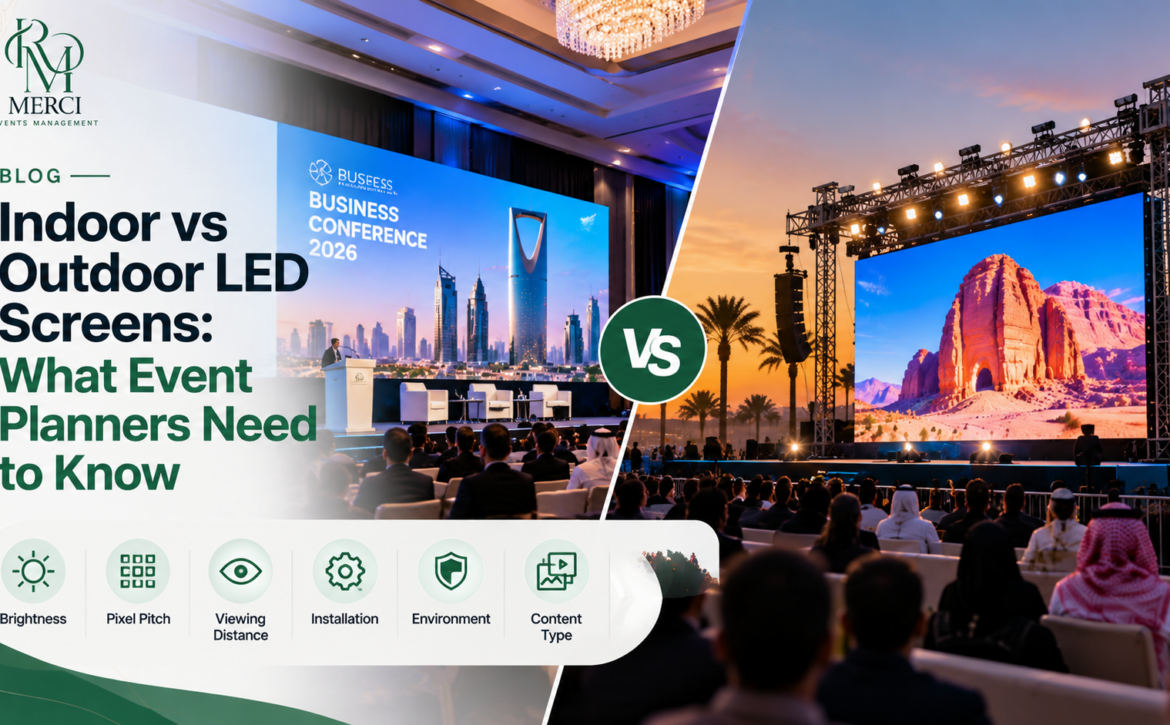
Although both technologies serve the same basic purpose—displaying video, presentations, branding and live content—the environment in which they operate creates important differences in brightness, weather protection, viewing distance and installation.

Understanding those differences can help you choose a screen that performs properly throughout your event.

What Is an Indoor LED Screen?

An indoor LED screen is designed primarily for controlled environments such as:

  • Conference halls
  • Exhibition venues
  • Hotels
  • Ballrooms
  • Meeting spaces
  • Indoor stages
  • Shopping malls
  • Corporate event venues

Because indoor venues usually have controlled lighting and protection from weather, these screens don’t need the same level of environmental protection as outdoor displays.

Indoor LED screens are commonly used behind conference stages, inside exhibition booths, for presentations, branded event content and live camera feeds.

If you’re planning this type of setup, you can explore Merci Event’s LED Screen Rental in Saudi Arabia services for indoor and event-display solutions.

What Is an Outdoor LED Screen?

Outdoor LED screens are designed for environments where displays may be exposed to stronger sunlight and changing weather conditions.

Typical applications include:

  • Outdoor festivals
  • Public events
  • Large ceremonies
  • Outdoor exhibitions
  • Sports events
  • Concerts
  • Brand activations
  • Outdoor corporate events

An outdoor display needs to remain visible in much brighter conditions than most indoor screens.

It also needs suitable protection for the environment in which it will operate.

This makes outdoor LED planning different from simply moving an indoor display outside.

1. Brightness Is One of the Biggest Differences

Brightness is a major consideration when comparing indoor and outdoor LED screens.

Inside a conference hall or ballroom, event planners can usually control much of the lighting around the display.

Outdoors, that’s much more difficult.

Direct or strong ambient daylight can make an inadequately bright display difficult to see. Outdoor LED systems therefore generally require substantially higher brightness capability than indoor installations.

But more brightness isn’t automatically better.

An excessively bright screen inside a dark conference hall can be uncomfortable for attendees and may not look ideal on camera.

The correct brightness should match the event environment.

2. Weather Protection Matters Outdoors

Indoor event screens operate in relatively protected environments.

Outdoor displays may need to deal with conditions such as dust, wind, heat or moisture depending on the venue and weather.

That’s why event planners should confirm that the LED system is suitable for the intended outdoor environment.

Weather protection is particularly important for events in Saudi Arabia, where outdoor productions may encounter heat, dust and strong sunlight.

The supporting structure, electrical setup and installation environment also need to be considered—not only the LED panels themselves.

3. Pixel Pitch Can Be Different

Pixel pitch describes the distance between LED pixels and is an important factor in determining how a screen looks at different viewing distances.

Generally, displays intended to be viewed from closer distances benefit from a finer pixel pitch.

This is particularly relevant for indoor applications.

Imagine an exhibition booth where visitors stand only a few metres from the screen. They may be viewing detailed graphics, text, product videos and presentations.

Now compare that with a large outdoor event where much of the audience is considerably farther away.

The appropriate specification can be different.

Rather than choosing a screen based solely on physical dimensions, event planners should consider:

screen size + pixel pitch + audience distance + content

together.

4. Viewing Distance Changes the Decision

Where will the audience actually be?

This question is often more useful than simply asking:

“How big should the LED screen be?”

A screen used inside a small conference room has very different requirements from a screen positioned behind a large outdoor stage.

Consider:

  • Distance to the first row
  • Distance to the last row
  • Number of attendees
  • Venue width and depth
  • Seating arrangement
  • Screen position
  • Whether attendees need to read text
  • Whether the screen primarily shows video

For more help with this decision, read our guide What Size LED Screen Do You Need for an Event?

5. Content Matters Too

The content shown on the LED screen should influence your technical decisions.

For example, a corporate conference may display:

  • PowerPoint presentations
  • Speaker names
  • Charts
  • Small text
  • Company branding
  • Live camera feeds

Clarity becomes especially important when attendees need to read detailed information.

An outdoor festival might rely more heavily on:

  • Live video
  • Sponsor graphics
  • Large logos
  • Animations
  • Performance visuals

The screen specification should therefore be selected around the actual content, rather than treating every event as technically identical.

6. Installation Requirements Are Different

Indoor LED screens are often installed on stages, truss systems, exhibition structures or suitable ground-support systems.

Outdoor installations can require additional planning.

Event teams may need to consider:

  • Structural support
  • Screen positioning
  • Wind exposure
  • Weather conditions
  • Power requirements
  • Cable routing
  • Audience safety
  • Equipment access
  • Setup and dismantling

For larger events, the LED screen should be considered part of the overall production design rather than an isolated piece of equipment.

7. Indoor vs Outdoor LED Screen: Which Should You Choose?

There isn’t one answer for every event.

An indoor LED screen is generally appropriate when the display will operate inside a controlled venue and the audience may be relatively close to the screen.

An outdoor LED screen is designed for environments where greater brightness and appropriate environmental protection may be necessary.

However, event planners should avoid choosing equipment based only on the words “indoor” or “outdoor.”

The final decision should also consider:

Venue → audience → viewing distance → content → screen size → pixel pitch → lighting → installation conditions

All of these factors affect the final viewing experience.

What About Semi-Outdoor Events?

Some events fall somewhere between a conventional indoor and outdoor setup.

For example:

  • Covered outdoor venues
  • Temporary event structures
  • Tents
  • Open-sided event spaces
  • Entrances and reception areas
  • Screens positioned near large windows

These environments need to be evaluated individually.

A covered location doesn’t necessarily have the same lighting or environmental conditions as an indoor ballroom.

This is why event planners should provide the LED supplier with information about the actual installation location, rather than simply requesting an indoor or outdoor screen.

Common LED Screen Mistakes Event Planners Should Avoid

One common mistake is selecting a screen based only on price or dimensions.

Other mistakes include choosing inappropriate brightness, ignoring viewing distance, selecting the wrong pixel pitch, failing to consider the content resolution, or leaving installation planning until the final stages of production.

Another mistake is treating the LED display separately from the rest of the event.

The screen needs to work with the stage, lighting, audio, cameras, branding and overall venue layout.

For conferences in particular, integrating these elements early can produce a much cleaner result. Merci Event’s Conference Management Services in Saudi Arabia can support the wider event-production process.

LED Screens for Exhibitions

Exhibitions create another interesting use case.

Visitors may stand extremely close to an LED wall, meaning image quality and pixel pitch can become particularly important.

LED displays can be integrated into exhibition booths for product videos, brand storytelling, demonstrations and promotional content.

If you’re planning an exhibition, explore our Exhibition Management Services in Saudi Arabia for exhibition planning, production and technical support.

Planning an LED Screen for an Event in Saudi Arabia?

The best LED screen isn’t necessarily the biggest or brightest option.

It’s the screen that suits the venue, audience, content and environment.

Before choosing an LED display, determine whether the installation will be indoors or outdoors, how far away the audience will be, what content will appear on the screen and how the display fits into the overall event production.

Merci Event provides LED Screen Rental in Saudi Arabia for conferences, exhibitions, corporate events and other productions.

Our team can help evaluate your event requirements and recommend an appropriate LED setup based on your venue and event format.

Planning an upcoming event? Contact Merci Event to discuss your LED screen and event-production requirements.

Frequently Asked Questions

What is the main difference between indoor and outdoor LED screens?

Outdoor LED screens generally require greater brightness and suitable protection for outdoor operating conditions. Indoor LED screens are designed for more controlled environments where viewers may also be closer to the display.

Can I use an indoor LED screen outdoors?

Equipment should be used according to its intended technical and environmental specifications. An indoor screen may not provide the brightness or environmental protection required for an outdoor event.

Are outdoor LED screens brighter than indoor screens?

Generally, yes. Outdoor displays often need higher brightness to remain visible under strong ambient light and daylight conditions.

Which LED screen is best for a conference?

It depends on the venue size, audience viewing distance, stage design and content. Conferences displaying presentations and detailed text may particularly benefit from careful consideration of resolution and pixel pitch.

What pixel pitch should I choose for an event?

There isn’t one pixel pitch suitable for every event. Viewing distance, screen dimensions, content and venue conditions should all be considered when choosing the appropriate specification.

How do I choose the right LED screen size?

Consider the distance between the screen and the audience, venue dimensions, content, stage design and expected attendance. Read our What Size LED Screen Do You Need for an Event? guide for a more detailed explanation.

corporate event permit Saudi Arabia
permitsevents
[ September 29, 2026 by events 0 Comments ]

Do Corporate Events Need a Permit in Saudi Arabia? (2026)

Saudi Arabia has become a major destination for conferences, exhibitions, corporate meetings, workshops, product launches and professional events. As more companies organize events across the Kingdom, one question frequently comes up during planning:

Do corporate events need a permit in Saudi Arabia?

The answer depends on the type, purpose and activities of the event. A small internal company meeting is very different from a large conference, professional workshop, exhibition or corporate event featuring entertainment.

Understanding the applicable requirements early can help organizers avoid unnecessary delays and keep the event planning process on track.

Do All Corporate Events in Saudi Arabia Need a Permit?

Not every corporate gathering should be treated the same way.

The permit or approval requirements can depend on several factors, including:

  • Type of event
  • Purpose of the gathering
  • Number and type of attendees
  • Venue
  • Event activities
  • Whether the event is public or private
  • Whether entertainment is included
  • Whether it includes a conference, exhibition, workshop or training activity

For this reason, companies should determine the exact nature of their event before deciding which permit process may apply.

If you’re unsure where to begin, Merci Event provides SCEGA Permit Services in Saudi Arabia to support organizers through the relevant application process.

Corporate Conferences in Saudi Arabia

Corporate conferences can range from small professional gatherings to major industry events involving speakers, sponsors, exhibitors and hundreds of attendees.

Because conferences fall within Saudi Arabia’s regulated business-events environment, permit requirements should be considered during the early planning stages.

Companies organizing a conference should establish important details such as the event purpose, dates, venue, speakers, audience and planned activities before beginning the relevant application process.

Merci Event provides Conference Management Services in Saudi Arabia alongside permit application support for companies organizing professional events.

Workshops and Training Events

Workshops and training programs are another common form of corporate event.

Companies may organize them for:

  • Employee development
  • Professional education
  • Customer training
  • Industry discussions
  • Product demonstrations
  • Knowledge-sharing sessions

Depending on the structure of the activity, relevant approvals may need to be considered.

Organizers planning these events can explore our SCEGA Permit Services in Saudi Arabia for assistance with understanding the process and preparing an application.

For a more detailed explanation of the application process, read How to Apply for a SCEGA Permit in Saudi Arabia (2026).

Corporate Exhibitions and Business Events

Some companies organize exhibitions as standalone events, while others include exhibition areas within larger conferences or corporate gatherings.

These events can involve exhibitors, sponsors, booths, visitor registration, branding, audiovisual equipment and other production requirements.

Because an exhibition can be considerably more complex than a standard company meeting, both regulatory requirements and event operations should be considered well in advance.

If you’re planning this type of event, explore our Exhibition Management Services in Saudi Arabia for planning and production support.

What If a Corporate Event Includes Entertainment?

This is an important distinction.

Imagine a company is organizing a product launch. The program includes presentations and business networking during the day, followed by live entertainment for guests.

The event may have different requirements from a conventional corporate meeting.

Entertainment-related activities can involve different permit considerations, so organizers should evaluate everything happening during the event, rather than relying only on the event’s title.

For entertainment-related events, Merci Event provides GEA Permit Services in Saudi Arabia to assist organizers with the application process.

You can also read our guide GEA Permit in Saudi Arabia: Requirements & Application Process (2026) for an overview of the process.

SCEGA or GEA Permit for a Corporate Event?

This is one of the most common questions event organizers face.

Generally, business-event activities such as conferences, meetings, workshops and related professional events may involve SCEGA requirements, while entertainment activities can involve GEA requirements.

However, the correct route depends on the actual activities being organized.

For example, calling something a “corporate event” doesn’t automatically determine which permit applies. A corporate conference and a corporate entertainment event can have very different requirements.

We’ve covered this distinction in detail in SCEGA vs GEA Permit in Saudi Arabia: Which One Do You Need? (2026).

When Should You Start Checking Permit Requirements?

Permit planning should begin early in the event-planning process.

A common mistake is focusing first on the stage, suppliers, invitations, speakers and marketing, and only thinking about permits shortly before the event.

A better sequence is:

Event concept → Event type → Venue → Activities → Permit requirements → Production → Promotion

This allows the organizing team to identify possible regulatory requirements before too many commitments have been made.

Approval times can also vary according to the event and application circumstances.

We’ve explained this topic separately in How Long Does an Event Permit Take in Saudi Arabia? (2026).

What Information Should Corporate Event Organizers Prepare?

The exact requirements depend on the event and applicable process, but organizers should have their core event information clearly defined.

This can include:

  • Event name and purpose
  • Proposed dates
  • Venue
  • Organizer information
  • Event format
  • Expected audience
  • Speakers or participants
  • Planned activities
  • Exhibition components
  • Entertainment activities, if applicable

Having clear and consistent event information can make the application and planning process easier.

Major changes to the venue, event format, dates or activities later in the process can create additional complications.

Can You Plan the Event First and Deal With the Permit Later?

It is better to consider permit requirements before the event reaches the final production stage.

For example, imagine that a company has already booked suppliers, designed the stage, announced speakers and started promoting an event before confirming the applicable permit requirements.

If additional documentation, approvals or changes are then required, the event team has much less flexibility.

Early permit planning gives organizers more time to address requirements without disrupting the rest of the event.

Corporate Event Planning Goes Beyond Permits

Obtaining the appropriate approval is only one part of delivering a successful corporate event.

Companies may also need to coordinate:

  • Event concept and planning
  • Venue setup
  • Stage production
  • LED screens
  • Sound systems
  • Lighting
  • Branding
  • Exhibition booths
  • Registration areas
  • Presentations
  • Technical teams
  • On-site event operations

For events requiring large-format displays and presentation systems, explore our LED Screen Rental in Saudi Arabia services.

Merci Event also provides broader event-management and production support for corporate events, conferences and exhibitions across Saudi Arabia.

So, Does Your Corporate Event Need a Permit?

The most accurate answer is:

It depends on what you are organizing.

Instead of asking only whether a “corporate event” needs a permit, ask:

What type of event are we organizing?

A private internal meeting, professional workshop, training program, conference, exhibition and entertainment-focused product launch are not necessarily treated in the same way.

Determine the event format and activities first. From there, it becomes much easier to identify which permit or approval process may apply.

Need Help With a Corporate Event Permit in Saudi Arabia?

Merci Event supports companies, agencies and event organizers with event permit application assistance in Saudi Arabia.

Whether you’re planning a conference, workshop, training event, exhibition or an event involving entertainment, our team can help you understand the relevant process and prepare for the next steps.

Explore our SCEGA Permit Services in Saudi Arabia for business-event permit support or our GEA Permit Services in Saudi Arabia for entertainment-related event requirements.

Planning an upcoming corporate event? Contact Merci Event to discuss your event and permit requirements.

Frequently Asked Questions

Do corporate events need a permit in Saudi Arabia?

It depends on the type and activities of the event. Conferences, workshops, training programs, exhibitions and events involving entertainment can have different permit or approval requirements.

Do corporate conferences require a permit?

Corporate conferences may fall within relevant business-event requirements. Organizers should check the applicable process based on the conference format and activities before finalizing the event.

Does a corporate workshop need a SCEGA permit?

Workshops can fall within SCEGA-related business-event requirements depending on the event and organizer. Merci Event can assist organizers with understanding and preparing for the relevant SCEGA permit process.

What if my corporate event includes entertainment?

Entertainment activities can introduce different regulatory requirements. If entertainment forms part of the event, organizers should determine whether GEA-related approval or permitting requirements apply.

Should I arrange the permit before booking event suppliers?

Permit requirements should be investigated early. This helps organizers understand potential regulatory requirements before making major commitments to production, promotion and suppliers.

Can Merci Event issue a SCEGA or GEA permit?

Merci Event provides permit application and approval support. The relevant Saudi authority remains responsible for issuing the applicable permit or approval.

ChatGPT Image Sep 21, 2026, 03_24_13 PM
permits
[ September 21, 2026 by events 0 Comments ]

How Long Does an Event Permit Take in Saudi Arabia? (2026)

If you are organizing a conference, exhibition, workshop, corporate event, festival or entertainment event in Saudi Arabia, permits should be considered early in the planning process.

One of the most common questions organizers have is:

How long does it take to get an event permit in Saudi Arabia?

There is no single approval time that applies to every event. The timeline depends on the type of event, responsible authority, permit category, venue, required documents and whether additional approvals are needed.

Understanding these factors can help organizers avoid unnecessary delays.


Why Event Permit Approval Times Vary

Saudi Arabia has different regulatory processes for different types of events.

For example, the Saudi Conventions & Exhibitions General Authority (SCEGA) provides electronic licensing and approval services covering business-event activities. Its current portal includes services associated with conferences and other activities such as meetings, workshops, training courses and lectures.

Entertainment activities may instead fall under the General Entertainment Authority (GEA).

This means the first step isn’t asking:

“How quickly can I get a permit?”

It is determining:

“Which permit does my event actually require?”

If you’re unsure, read our SCEGA vs GEA Permit in Saudi Arabia guide before beginning the application.


How Long Does a SCEGA Permit Take?

There isn’t one processing time that should be applied to every SCEGA event.

The appropriate process depends on the event category and service being requested.

SCEGA’s current electronic portal provides licensing services as well as government-approval services covering activities including meetings, workshops, training courses, lectures and conferences.

Different event categories can therefore have different application requirements and planning periods.

For organizers, the safest approach is to identify the correct SCEGA service early and check its current requirements and submission conditions rather than assuming that a previous event’s timeline will apply.

For more information about the application itself, see our How to Apply for a SCEGA Permit in Saudi Arabia guide.


How Long Does a GEA Permit Take?

For entertainment events, GEA provides more specific published information.

Its current Entertainment Event Permit document lists an issuance duration of 30 days. The same guidance covers entertainment-event activities and requires event information such as the concept, location, date, entertainment content, expected attendance and target audience.

This does not mean every Saudi event permit takes 30 days.

It applies specifically to the GEA Entertainment Event Permit described in that guidance. Other activities and approvals can have different requirements.

If you’re planning an entertainment activity, our GEA Permit in Saudi Arabia guide explains the process in more detail.


What Can Delay an Event Permit?

Even when an application has a defined process, several issues can slow things down.


1. Applying for the Wrong Permit

A conference and an entertainment festival aren’t necessarily regulated through the same process.

Submitting through the wrong route can create unnecessary delays before the actual application has even started.


2. Incomplete Event Information

Permit applications can require information about the event itself, organizer, venue and activities.

Missing or inconsistent information may require clarification or correction.

Before applying, make sure the event’s:

name, date, location, activities, organizer details and program

are accurate and consistent.


3. Venue Issues

The venue should also be considered early.

Certain applications can involve venue-related requirements, and the suitability or approval status of the location may affect the process.

Changing the venue later can also create additional administrative work.


4. Changes After Submission

Event plans often change.

The venue changes. The dates move. New activities are added. The event concept expands.

However, significant changes can affect an existing permit application or approval.

This is why organizers should try to finalize the key event details before submitting rather than treating the permit application as the first draft of the event plan.


5. Additional Approvals

Some events may involve requirements beyond the primary event permit.

The exact authorities involved depend on the activities, venue and nature of the event.

Organizers should therefore avoid assuming that obtaining one approval automatically satisfies every regulatory requirement associated with the event.


How Early Should You Start the Permit Process?

The practical answer is:

Start earlier than you think you need to.

Permit planning should ideally begin alongside venue selection and event planning—not after everything else has already been confirmed.

Historical SCEGA guidance also illustrates why planning periods can differ considerably by event category: published guidance has specified substantially different lead times for conferences/trade exhibitions compared with meetings, workshops and training activities. Organizers should verify today’s applicable service requirements directly with SCEGA rather than relying on an old timeline.

Starting early gives your team time to:

    • Identify the correct permit
    • Prepare required information
    • Confirm venue requirements
    • Correct documentation if necessary
    • Coordinate additional approvals
    • Respond to requests for clarification
    • Manage changes without putting the event date at risk


This becomes especially important for large conferences, exhibitions and entertainment events involving multiple suppliers and stakeholders.

 Can You Promote an Event While Waiting for Approval?


Be careful here.

Marketing, ticketing and public promotion should be planned around the conditions attached to the relevant event approval.

Don’t assume that submitting an application means the event has already been approved.

For business events, check the latest SCEGA requirements applicable to the specific event category before beginning public promotion. For entertainment activities, check the corresponding GEA requirements.

This is another reason permit planning should happen before the marketing campaign is fully launched.


How Can You Reduce the Risk of Permit Delays?

The best way to reduce avoidable delays is to prepare properly before submitting.

Confirm the event category and responsible authority first. Then prepare accurate organizer information, event details, dates, venue information and program/activity information according to the applicable service.

Most importantly, don’t rely on a generic permit checklist downloaded from another event.

A workshop, conference, exhibition and entertainment event may have very different requirements.


Plan Your Saudi Event Permit Early

Saudi Arabia’s business-events sector continues to expand, and SCEGA describes the Kingdom as a rapidly growing MICE market with increasing activity across conferences, exhibitions and international events.

For event organizers, regulatory planning should therefore be treated as part of the overall event-production timeline.

The question shouldn’t only be:

“How long will my permit take?”

A better question is:

“Which permit does my event require, what information is needed, and when should we begin?”

Answering those questions early can make the rest of the event-planning process considerably smoother.


Need Help With an Event Permit in Saudi Arabia?

Merci Event supports organizers with event permit applications in Saudi Arabia, including SCEGA and GEA-related event requirements.

If you are planning a conference, workshop, meeting, exhibition or other business event, explore our SCEGA Permit Services in Saudi Arabia.

For entertainment activities, visit our GEA Permit Services in Saudi Arabia.

You can also contact Merci Event to discuss your event and determine the appropriate permit process before moving ahead with production.


Frequently Asked Questions


How long does an event permit take in Saudi Arabia?

There is no universal processing time. It depends on the event type, authority and specific permit. GEA currently lists a 30-day issuance duration for its Entertainment Event Permit, while other event permits and SCEGA services can follow different timelines.


How long does a SCEGA permit take?

SCEGA covers multiple business-event categories and services, so organizers should check the current requirements for their specific event rather than applying one timeline to every SCEGA permit.


How long does a GEA entertainment event permit take?

GEA’s current published Entertainment Event Permit information lists an issuance duration of 30 days. Requirements can still depend on the particular activity and application.


Should I arrange the permit before planning the event?

Permit planning should begin early, alongside decisions such as the event type, venue, dates and activities. This helps identify regulatory requirements before major commitments are made.


ChatGPT Image Sep 8, 2026, 01_47_32 PM
permits
[ September 8, 2026 by events 0 Comments ]

GEA Permit in Saudi Arabia: Requirements & Application Process (2026)

Saudi Arabia’s entertainment industry continues to grow, with concerts, festivals, live performances, entertainment exhibitions, and other experiences taking place across the Kingdom.

If you are planning an entertainment event in Saudi Arabia, obtaining the correct approval from the General Entertainment Authority (GEA) may be an important part of the planning process.

This guide explains what a GEA permit is, which activities may require GEA approval, and the general process organizers should consider when preparing an entertainment event in Saudi Arabia.

What Is a GEA Permit?

A GEA permit is an authorization issued by Saudi Arabia’s General Entertainment Authority for activities that fall within the entertainment sector.

GEA regulates and supervises entertainment activities in the Kingdom. Its licensing framework includes permits for organizing entertainment events as well as other entertainment-related activities.

The exact permit required depends on the type of activity being organized.

For event organizers, identifying the correct permit early can help avoid delays and complications later in the planning process.

Which Events May Require a GEA Permit?

GEA permits are generally associated with entertainment-focused events and activities.

Depending on the nature of the event, this may include:

  • Concerts and musical performances
  • Festivals
  • Live entertainment
  • Theatrical performances
  • Entertainment exhibitions
  • Public entertainment activities
  • Other events involving entertainment performances or experiences

However, not every event in Saudi Arabia falls under GEA.

Conferences, exhibitions, workshops, meetings, and certain professional events may instead fall under the Saudi Conventions & Exhibitions General Authority (SCEGA) or another relevant authority.

If you are unsure which authority applies to your event, read our SCEGA vs GEA Permit in Saudi Arabia: Which One Do You Need? guide.

How to Apply for a GEA Permit in Saudi Arabia

The exact application requirements can vary depending on the entertainment activity being organized. However, event organizers can generally prepare for the process through the following steps.

1. Identify the Type of Entertainment Activity

The first step is to clearly define your event.

Consider what activities will take place, who will participate, where the event will be held, and whether live entertainment or performances will be included.

For example, the regulatory requirements for a concert may be different from those for an entertainment exhibition or another type of live event.

Clearly defining the event helps determine which permit or approval may be required.

2. Confirm the Correct Authority

One of the most important steps is determining whether your event falls under GEA, SCEGA, or another Saudi authority.

Entertainment-focused events may require GEA approval, while conferences, exhibitions, workshops, and similar business events may involve SCEGA requirements.

Checking this before starting the application can prevent unnecessary delays.

You can also read our Event Permit in Saudi Arabia: Requirements & Types guide for an overview of the different event permit categories.

3. Prepare the Event Information

Before submitting an application, prepare accurate information about the planned event.

Depending on the event and applicable requirements, this may include information relating to:

  • Event type and activities
  • Event dates
  • Venue
  • Organizer
  • Entertainment program
  • Performers or participants
  • Operational arrangements
  • Other supporting information or documents

Requirements can differ according to the event, so organizers should check the latest applicable GEA requirements before submission.

4. Submit the Permit Application

Once the relevant information and documents are prepared, the application can be submitted through the appropriate GEA electronic service.

It is important that the information submitted accurately reflects the event being planned.

Incomplete or inconsistent information can create unnecessary complications during the review process.

5. Follow the Application Status

After submission, organizers should monitor the application and respond to any requests for additional information or changes.

Permit approval should also be considered as part of the overall event timeline.

Waiting until the final stages of production to begin the permit process can create problems with other areas such as venue arrangements, performers, production, marketing, and event operations.

GEA Permit vs SCEGA Permit

GEA and SCEGA permits are not the same.

GEA primarily deals with entertainment-sector activities, while SCEGA regulates activities within the exhibitions and conferences sector.

For example, a concert or entertainment festival may involve GEA, while a conference, workshop, or professional exhibition may involve SCEGA.

ome events can also include multiple activities, making it important to understand the event structure before deciding which approval route applies.

For a detailed comparison, see our SCEGA vs GEA Permit in Saudi Arabia guide.

How Long Does GEA Permit Approval Take?

There is no single processing time that should be assumed for every entertainment event.

The timeline can depend on factors such as the type of activity, completeness of the application, supporting requirements, and whether additional information or approvals are required.

For this reason, organizers should begin permit planning as early as possible rather than relying on a last-minute application.

Common GEA Permit Mistakes to Avoid

A few planning mistakes can make the approval process more difficult than necessary.

One common problem is applying through the wrong regulatory route because the organizer has not clearly identified whether the event is primarily an entertainment event, conference, exhibition, or another activity.

Other issues can include incomplete event information, changes to the event after submission, or starting the permit process too close to the planned event date.

Preparing the event details early and confirming the applicable requirements can make the process more manageable.

Need Help With a GEA Permit in Saudi Arabia?

Managing permits alongside venue coordination, production, suppliers, performers, and event operations can take significant time.

Merci Event provides GEA permit assistance and event management support in Saudi Arabia, helping organizers navigate the permit process and prepare for their entertainment events.

Whether you are planning a concert, festival, live performance, entertainment exhibition, or another applicable entertainment activity, our team can assist with the permit process and wider event requirements.

Need assistance with your upcoming event? Contact Merci Event for GEA permit support in Saudi Arabia.

Frequently Asked Questions

What is a GEA permit in Saudi Arabia?

A GEA permit is an authorization associated with entertainment activities regulated by Saudi Arabia’s General Entertainment Authority. The applicable permit depends on the type of entertainment activity being organized.

What events may require GEA approval?

Concerts, festivals, theatrical performances, entertainment exhibitions, live performances, and other entertainment-focused activities may fall under GEA requirements depending on the nature of the event.

Is a GEA permit the same as a SCEGA permit?

No. GEA primarily regulates entertainment-sector activities, while SCEGA regulates the exhibitions and conferences sector. The correct authority depends on the type and activities of the event.

When should I start the GEA permit process?

It is better to consider permit requirements during the early planning stages. Processing and requirements can vary depending on the event, so organizers should avoid leaving permit applications until the last minute.

Can Merci Event assist with GEA permits?

Yes. Merci Event provides GEA permit assistance and event management support for applicable events in Saudi Arabia.

ChatGPT Image Aug 31, 2026, 02_57_55 PM
permits
[ August 31, 2026 by events 0 Comments ]

How to Apply for a SCEGA Permit in Saudi Arabia (2026)

Organizing a conference, workshop, training program, seminar or other business event in Saudi Arabia may require approval or licensing through the Saudi Conventions and Exhibitions General Authority (SCEGA).

If you already know that your event falls under SCEGA, the next question is simple: How do you apply for the permit?

This guide explains the application process and what event organizers should prepare before submitting their request.

Step 1: Identify the Correct Event Category

The first step is determining the correct category for your event.

SCEGA’s electronic services cover different types of business events, including conferences, exhibitions, forums, seminars, workshops, meetings, training courses and lectures.

Because the requirements can vary according to the event category, selecting the appropriate service from the beginning is important.

If you’re unsure whether your event falls under SCEGA or another authority, read our SCEGA vs GEA Permit in Saudi Arabia guide.

Step 2: Prepare Your Event Information

Before beginning the application, organize the important details about your event.

Depending on the event type and applicable service, you may need information relating to:

  • Event name and type
  • Organizer information
  • Proposed event dates
  • Event location or venue
  • Event activities and program
  • Speakers or participants, where applicable
  • Supporting documents required for the relevant application

Requirements can vary, so organizers should always verify the latest requirements for their specific event through the official SCEGA electronic services.

Step 3: Check Your Event Venue

Don’t leave the venue check until the last minute.

SCEGA’s current FAQ explains that when an intended venue is not available within the electronic portal, the venue operator may need to register the location and complete the required approval process.

This makes venue selection an important part of permit planning, especially when you’re working with a new or unusual event location.

Step 4: Submit the Application Through the SCEGA Portal

Once the required event information is ready, the appropriate application can be submitted through SCEGA’s electronic services.

Make sure the information entered in the application matches your actual event plan.

Check details such as:

Event type → Dates → Venue → Organizer details → Event program → Supporting documents

Incorrect or incomplete information can create additional work later in the process.

Step 5: Review Before Final Submission

Before submitting, review the application carefully.

Pay particular attention to:

  • Correct event classification
  • Correct dates and location
  • Organizer information
  • Required documents
  • Event program details
  • Consistency between the application and actual event plan

This simple review can help prevent avoidable problems during processing.

Step 6: Follow the Application and Approval Process

After submission, the application goes through the relevant review process.

Processing requirements are not necessarily identical for every event category. Organizers should therefore avoid assuming that another event’s approval time, documents or fees will automatically apply to their own event.

Plan the permit process early in your event timeline, rather than waiting until production and promotion are already underway.

Can You Promote the Event Before SCEGA Approval?

This is particularly important for marketing teams.

SCEGA’s published FAQ states that promotional activities, including advertising, should not take place before obtaining the required license or approval.

That means permit planning should be coordinated with your marketing schedule, not treated as a separate last-minute administrative task.

Common SCEGA Application Mistakes

Several avoidable mistakes can make event licensing more complicated:

  • Choosing the wrong event category
  • Starting the application too late
  • Providing incomplete event information
  • Not checking the venue early enough
  • Changing important event details after applying
  • Starting promotion before receiving the necessary approval

If significant details such as the venue change after licensing, additional procedures may be required.

Good preparation from the beginning can make the overall process much easier to manage.

Need Help With Your SCEGA Permit?

Managing a permit application while simultaneously coordinating the venue, production, suppliers and event program can take time.

Merci Event provides SCEGA permit assistance in Saudi Arabia, helping organizers understand the appropriate process and prepare their event information for the relevant application.

Whether you’re planning a conference, workshop, training program, meeting or other business event, our team can assist you with the permit process and wider event requirements.

ChatGPT Image Aug 25, 2026, 02_09_38 PM
events
[ August 25, 2026 by events 0 Comments ]

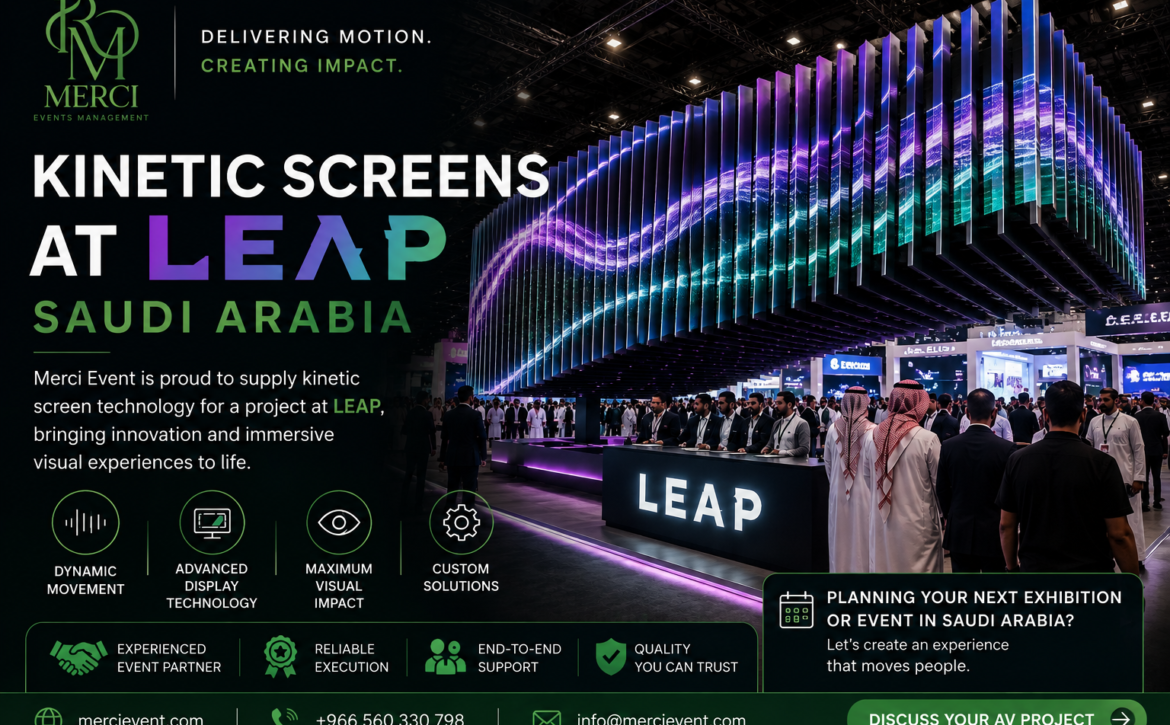
Merci Event Supplies Kinetic Screens for LEAP in Saudi Arabia

Saudi Arabia continues to raise the standard for exhibitions and technology events, where brands are increasingly looking for innovative ways to attract attention and create memorable visitor experiences.

As part of a project at LEAP in Saudi Arabia, Merci Event is supplying kinetic screen technology, bringing movement, digital content and visual innovation together to create a more engaging exhibition experience.

For Merci Event, the project reflects our growing capabilities in delivering advanced AV and display solutions for exhibitions and events across Saudi Arabia.

Bringing Kinetic Screen Technology to LEAP

LEAP brings together technology companies, innovators, investors and industry leaders, making visual presentation an important part of the exhibition experience.

Traditional displays communicate information. Kinetic screens go a step further by adding physical movement to digital content.

The synchronized movement of display elements can transform a conventional screen into a dynamic visual installation designed to capture attention on a busy exhibition floor.

For our project at LEAP, Merci Event’s role includes supplying the kinetic screen solution and supporting its integration into the event environment.

What Are Kinetic Screens?

Kinetic screens combine digital display technology with controlled physical movement.

Depending on the installation, individual display elements can move in synchronized patterns while digital content is presented, creating a three-dimensional visual effect.

This makes kinetic display technology particularly suitable for:

  • Technology exhibitions
  • Corporate events
  • Product launches
  • Exhibition booths
  • Brand activations
  • Conferences and experiential installations

The result is more than a screen—it becomes part of the visitor experience.

Why Kinetic Displays Work for Exhibitions

At a major exhibition, hundreds of brands may compete for visitors’ attention simultaneously.

Movement naturally creates visual interest. When combined with digital content, lighting and creative production, kinetic displays can help a booth or activation stand apart from conventional exhibition screens.

For technology-focused events such as LEAP, they also complement the environment by communicating innovation through the physical experience itself.

Advanced AV Solutions from Merci Event

Kinetic screens are part of Merci Event’s broader capabilities in professional event technology.

Our team supports events and exhibitions in Saudi Arabia with solutions including LED screens, professional AV systems, digital displays and customized visual technologies.

From selecting suitable equipment to installation and technical coordination, the objective is to create reliable technology solutions that complement the event concept rather than simply adding equipment to a venue.

Looking for Kinetic Screens in Saudi Arabia?

Whether you’re preparing for a technology exhibition, corporate event, product launch or brand activation, Merci Event can help create a visual solution designed around your event.

Our work at LEAP demonstrates how kinetic screen technology can be used to transform a conventional digital display into a more engaging physical and visual experience.

Planning your next exhibition or event in Saudi Arabia?

Contact Merci Event to discuss kinetic screens, LED displays and professional AV solutions for your upcoming project.

ChatGPT Image Aug 23, 2026, 03_28_35 PM
permits
[ August 23, 2026 by events 0 Comments ]

SCEGA vs GEA Permit in Saudi Arabia: Which One Do You Need? (2026)

Planning an event in Saudi Arabia often requires approval from the relevant authority. Two names organizers commonly come across are SCEGA (Saudi Conventions and Exhibitions General Authority) and the General Entertainment Authority (GEA).

But which one applies to your event?

The answer mainly depends on the type and purpose of the event. Here’s a simple breakdown.

What Is a SCEGA Permit?

SCEGA is associated with Saudi Arabia’s conventions, exhibitions and professional/business events.

SCEGA requirements may apply when organizing activities such as:

  • Conferences
  • Exhibitions
  • Business meetings
  • Workshops and seminars
  • Training programs
  • Professional forums

If you’re planning a business or professional event, you can learn more about Merci Event’s SCEGA Permit Services in Saudi Arabia here:

SCEGA Permit Services in Saudi Arabia

What Is a GEA Permit?

The General Entertainment Authority (GEA) regulates activities within Saudi Arabia’s entertainment sector.

GEA requirements may be relevant for events and activities such as:

  • Concerts and music events
  • Live entertainment
  • Entertainment festivals
  • Theatre and stage performances
  • Public entertainment activities
  • Entertainment shows and activations

For assistance with entertainment-event licensing, see:

GEA Permit Services in Saudi Arabia

SCEGA vs GEA: What’s the Difference?

The easiest way to understand the difference is by looking at the main purpose of your event.

Your Event More Likely Relevant
Business conference SCEGA
Professional exhibition SCEGA
Workshop or seminar SCEGA
Business forum SCEGA
Concert GEA
Entertainment festival GEA
Live entertainment show GEA
Theatre/entertainment performance GEA

What If My Event Includes Both Business and Entertainment?

This is where organizers can get confused.

For example, you might organize a corporate conference with a live entertainment performance at the end.

In such cases, don’t assume that one approval automatically covers every part of the event. Different activities may involve different regulatory requirements.

It is better to review the complete event program before starting the application process.

How to Choose the Right Event Permit

Before applying, identify:

1. What type of event are you organizing?
Conference, exhibition, concert, festival, workshop, etc.

2. What activities will take place?
Speakers, performances, entertainment, exhibitions or training.

3. Who will attend?
Business professionals, invited guests or the general public.

4. Are multiple activities involved?
A mixed-format event may require additional approvals.

Understanding these details early can help avoid unnecessary delays during the licensing process.

Need Help With Your Event Permit in Saudi Arabia?

Choosing the correct approval is an important part of planning an event in Saudi Arabia.

Merci Event assists organizers with permit applications, documentation preparation and coordination for both professional and entertainment events.

For business and professional events:

Get SCEGA Permit Assistance

For entertainment events:

Get GEA Permit Assistance

However, this is a general guide. The exact approvals required can depend on the event’s activities, format, venue and other regulatory requirements.

Man with a pen signs a document
permits
[ August 12, 2026 by events 0 Comments ]

Event Permit in Saudi Arabia: Requirements & Types (2026)

Event Permit in Saudi Arabia: Complete Guide for Event Organizers

Planning a conference, exhibition, corporate gathering, concert, festival, workshop, or cultural programme in Saudi Arabia? One of the most important steps is determining which event permit in Saudi Arabia may apply to your activity.

Saudi Arabia has different regulatory pathways depending on the nature and purpose of an event. A business conference may have different approval requirements from a concert, cultural programme, exhibition, or entertainment activity.

For event organizers, understanding the correct permit or license before submitting an application can help avoid unnecessary delays, incomplete applications, and compliance problems.

This guide explains the main types of event permits in Saudi Arabia, how to determine which approval may apply, the documents organizers should prepare, and how the application process generally works.


Do You Need an Event Permit in Saudi Arabia?

Many organized events and activities in Saudi Arabia are subject to licensing or approval requirements. However, there is no single permit that applies identically to every type of event.

The appropriate approval can depend on factors such as:


    • Type and purpose of the event
    • Whether the event is business, entertainment, or cultural
    • Venue and location
    • Organizing entity
    • Audience and expected attendance
    • Speakers, performers, or participating organizations
    • Activities taking place during the event


For this reason, organizers should determine the applicable regulatory pathway before proceeding with an event.


Types of Event Permits in Saudi Arabia

Different authorities oversee different categories of events and activities. Three areas event organizers commonly encounter are SCEGA approvals, GEA permits, and cultural-event licensing.


SCEGA Permit

SCEGA approvals are relevant to eligible business and professional events such as conferences, meetings, workshops, training courses, forums, and certain exhibitions.

Organizations planning a business-focused event should establish whether their activity falls within SCEGA requirements before proceeding.

If you are organizing this type of event, visit our SCEGA Permit Services in Saudi Arabia page for dedicated application assistance.


GEA Permit

Entertainment activities can fall under the regulatory framework of Saudi Arabia’s General Entertainment Authority (GEA).

Depending on the activity, this can include concerts, live entertainment, festivals, performances, shows, and other entertainment-focused events.

Organizers planning entertainment activities can learn more through our GEA Permit Services in Saudi Arabia page.


Cultural Event License

Cultural programmes and activities may have separate licensing requirements depending on the nature of the event and the relevant cultural sector.

These may include certain art, heritage, literary, creative, fashion, film, and cultural activities.

Our Cultural Event License Services page provides more information for organizations planning cultural activities in Saudi Arabia.


Which Event Permit Do I Need?

The easiest way to understand the distinction is to start with the primary purpose of your event.


Event Type Approval Area to Investigate
Business Conference SCEGA
Corporate Workshop SCEGA
Professional Meeting SCEGA
Training Programme SCEGA
Business Forum SCEGA
Concert GEA
Entertainment Festival GEA
Live Performance GEA
Entertainment Show GEA
Cultural Programme Relevant cultural licensing
Art or Heritage Activity Relevant cultural licensing

This table should be treated as general guidance rather than a definitive licensing determination. Requirements can vary according to the exact activity and current regulations.


What Documents May Be Required for an Event Permit?

Documentation requirements differ according to the event and applicable authority. Organizers should therefore verify the current requirements for their specific activity.

Depending on the application, information or documents may include:


    • Event concept and description
    • Event programme or agenda
    • Dates and operating schedule
    • Organizer information
    • Company or entity documentation
    • Venue information
    • Speaker, trainer, artist, or performer information
    • Expected attendance
    • Floor plans where applicable
    • Supporting approvals or documentation requested for the activity


Preparing complete and accurate information before submission can reduce avoidable delays during the review process.


How Does the Event Permit Application Process Work?

Although the exact procedure varies by permit type, an event approval process will generally involve several stages.


1. Identify the Event Category

First, determine whether the proposed activity is primarily business, entertainment, cultural, or another regulated event type.


2. Identify the Applicable Approval

Once the event category is understood, determine which authority, license, or approval process applies.

This is an important step because submitting through the wrong regulatory pathway can create unnecessary delays.


3. Prepare the Documentation

Collect the event information and supporting documents required for the relevant application.


4. Submit the Application

Complete the applicable application process and submit the required information and documentation.


5. Respond to Additional Requirements

During review, additional information, corrections, or supporting documents may be requested.


6. Obtain the Required Approval

Once the relevant requirements have been satisfied, the appropriate approval can be issued subject to the applicable rules and conditions.


Common Event Permit Mistakes to Avoid

Permit delays are not always caused by the approval process itself. Problems can also arise when organizers begin the process without sufficient preparation.

Common issues include:


    • Applying for the wrong type of approval
    • Submitting incomplete documentation
    • Providing inconsistent event information
    • Changing the venue or programme after submission
    • Missing information about speakers or performers
    • Waiting until too close to the event date
    • Assuming one permit covers every activity within an event


For complex events involving several different activities, more than one approval may need to be considered.


How Early Should You Start the Permit Process?

Event organizers should investigate licensing requirements during the early planning stages rather than waiting until production is underway.

The appropriate lead time depends on the event type, scale, documentation, venue, participating individuals, and applicable authority.

Starting early provides more time to address missing information or additional regulatory requirements without placing unnecessary pressure on the event schedule.


Can One Event Require Multiple Approvals?

Potentially, yes.

A large event can contain several activities. For example, a business event could include an exhibition, entertainment performance, cultural programme, speakers, and other activities.

The approval requirements should therefore be assessed based on the actual components of the event rather than simply its marketing name.


Event Permit Assistance in Saudi Arabia

Navigating event permits can become complicated when an event involves different activities or regulatory requirements.

Merci Event assists businesses, organizations, agencies, and event organizers with identifying applicable permit requirements, preparing documentation, reviewing applications, coordinating submissions, and following up throughout the approval process.

Our permit services include:


    • SCEGA Permit Assistance
    • GEA Permit Assistance
    • Cultural Event License Assistance
    • Documentation preparation
    • Application support
    • Compliance guidance
    • Approval coordination


Need Help With an Event Permit in Saudi Arabia?

If you are planning an event and are unsure which permit or license applies, Merci Event can review your event requirements and guide you through the appropriate approval process.

From business conferences and workshops to entertainment and cultural activities, our team provides professional support with documentation, applications, regulatory coordination, and event approvals across Saudi Arabia.

Contact Merci Event to discuss your event permit requirements and start the approval process.


125170
Uncategorized
[ August 6, 2026 by events 0 Comments ]

The Complete Guide to SCEGA Permits in Saudi Arabia (2026)

Planning a conference, workshop, seminar, training programme, or business event in Saudi Arabia often involves obtaining the necessary regulatory approvals before the event can take place. One of the most important approvals for many business events is the SCEGA Permit.

Understanding the permit process, preparing the required documentation, and ensuring compliance with applicable regulations can save organisers significant time and help reduce delays.

This guide explains what a SCEGA Permit is, who may require one, the types of events it covers, the general application process, and how professional assistance can simplify the approval process.

What Is a SCEGA Permit?

A SCEGA Permit is an approval required for certain business events organised in Saudi Arabia. Depending on the nature of the event, organisers may need to obtain approval before conducting conferences, workshops, seminars, training programmes, meetings, or awareness exhibitions.

The purpose of the permit is to help ensure that organised events comply with applicable regulations and administrative requirements.

Who May Need a SCEGA Permit?

A SCEGA Permit may be required by various organisations planning eligible business events, including:

  • Corporate organisations
  • Government entities
  • Educational institutions
  • Professional associations
  • Non-profit organisations
  • International companies organising events in Saudi Arabia
  • Event management companies

Which Events May Require a SCEGA Permit?

Although licensing requirements vary depending on the event, SCEGA approvals commonly apply to business-related events such as:

  • Conferences
  • Seminars
  • Workshops
  • Training Courses
  • Business Meetings
  • Forums
  • Professional Gatherings
  • Awareness Exhibitions
  • Educational Events
  • Industry Conferences

If you are unsure whether your event requires approval, consulting an experienced permit specialist before planning the event can help avoid unnecessary delays.

Documents That May Be Required

The exact documentation depends on the type of event and applicable regulations. Organisers may be asked to provide documents such as:

  • Event proposal
  • Event agenda and programme
  • Venue confirmation
  • Organiser details
  • Commercial Registration (if applicable)
  • Speaker or trainer information
  • Floor plans (where applicable)
  • Supporting approvals requested by the relevant authority

Submitting complete and accurate documentation can help streamline the review process.

Permit requirements depend on the type of event, organiser, venue, and current regulatory requirements.

Connect Merci Events for Permits