
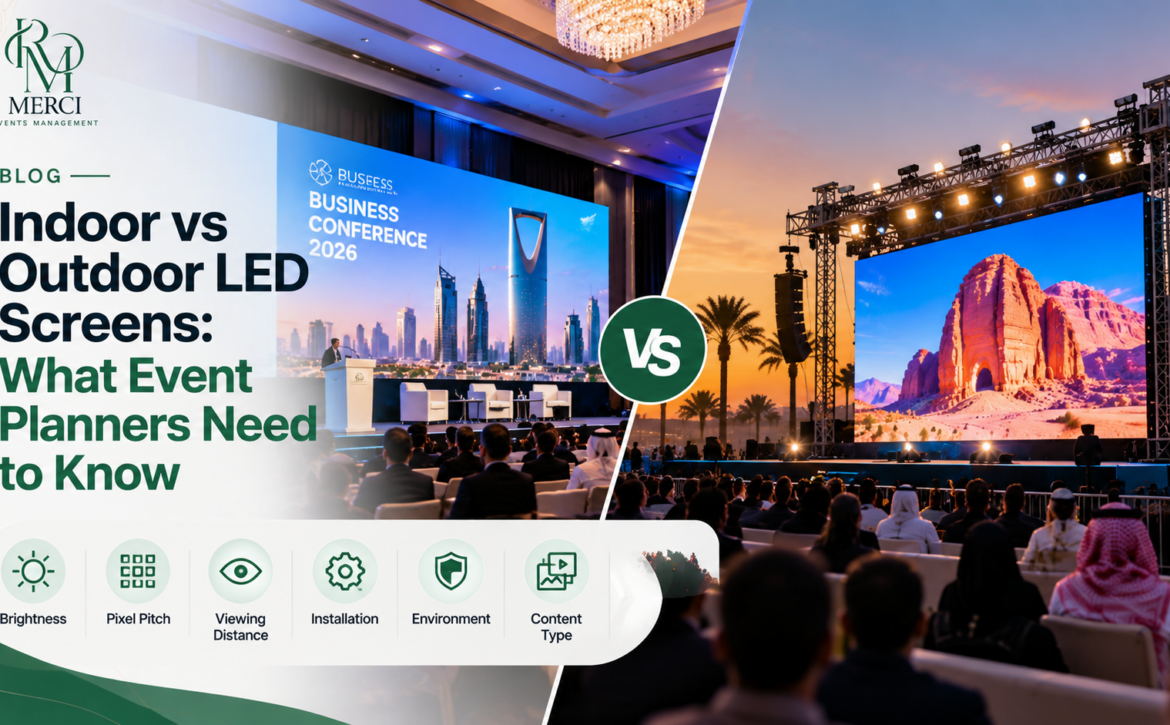
Indoor vs Outdoor LED Screens: What Event Planners Need to Know
LED screens have become an important part of modern events, from corporate conferences and exhibitions to product launches, festivals and outdoor celebrations.
But choosing an LED screen isn’t simply a matter of deciding how large the display should be.
One of the first decisions event planners need to make is whether the event requires an indoor or outdoor LED screen.
Although both technologies serve the same basic purpose—displaying video, presentations, branding and live content—the environment in which they operate creates important differences in brightness, weather protection, viewing distance and installation.
Understanding those differences can help you choose a screen that performs properly throughout your event.
What Is an Indoor LED Screen?
An indoor LED screen is designed primarily for controlled environments such as:
- Conference halls
- Exhibition venues
- Hotels
- Ballrooms
- Meeting spaces
- Indoor stages
- Shopping malls
- Corporate event venues
Because indoor venues usually have controlled lighting and protection from weather, these screens don’t need the same level of environmental protection as outdoor displays.
Indoor LED screens are commonly used behind conference stages, inside exhibition booths, for presentations, branded event content and live camera feeds.
If you’re planning this type of setup, you can explore Merci Event’s LED Screen Rental in Saudi Arabia services for indoor and event-display solutions.
What Is an Outdoor LED Screen?
Outdoor LED screens are designed for environments where displays may be exposed to stronger sunlight and changing weather conditions.
Typical applications include:
- Outdoor festivals
- Public events
- Large ceremonies
- Outdoor exhibitions
- Sports events
- Concerts
- تنشيط العلامات التجارية
- Outdoor corporate events
An outdoor display needs to remain visible in much brighter conditions than most indoor screens.
It also needs suitable protection for the environment in which it will operate.
This makes outdoor LED planning different from simply moving an indoor display outside.
1. Brightness Is One of the Biggest Differences
Brightness is a major consideration when comparing indoor and outdoor LED screens.
Inside a conference hall or ballroom, event planners can usually control much of the lighting around the display.
Outdoors, that’s much more difficult.
Direct or strong ambient daylight can make an inadequately bright display difficult to see. Outdoor LED systems therefore generally require substantially higher brightness capability than indoor installations.
But more brightness isn’t automatically better.
An excessively bright screen inside a dark conference hall can be uncomfortable for attendees and may not look ideal on camera.
The correct brightness should match the event environment.
2. Weather Protection Matters Outdoors
Indoor event screens operate in relatively protected environments.
Outdoor displays may need to deal with conditions such as dust, wind, heat or moisture depending on the venue and weather.
That’s why event planners should confirm that the LED system is suitable for the intended outdoor environment.
Weather protection is particularly important for events in Saudi Arabia, where outdoor productions may encounter heat, dust and strong sunlight.
The supporting structure, electrical setup and installation environment also need to be considered—not only the LED panels themselves.
3. Pixel Pitch Can Be Different
Pixel pitch describes the distance between LED pixels and is an important factor in determining how a screen looks at different viewing distances.
Generally, displays intended to be viewed from closer distances benefit from a finer pixel pitch.
This is particularly relevant for indoor applications.
Imagine an exhibition booth where visitors stand only a few metres from the screen. They may be viewing detailed graphics, text, product videos and presentations.
Now compare that with a large outdoor event where much of the audience is considerably farther away.
The appropriate specification can be different.
Rather than choosing a screen based solely on physical dimensions, event planners should consider:
screen size + pixel pitch + audience distance + content
together.
4. Viewing Distance Changes the Decision
Where will the audience actually be?
This question is often more useful than simply asking:
“How big should the LED screen be?”
A screen used inside a small conference room has very different requirements from a screen positioned behind a large outdoor stage.
Consider:
- Distance to the first row
- Distance to the last row
- Number of attendees
- Venue width and depth
- Seating arrangement
- Screen position
- Whether attendees need to read text
- Whether the screen primarily shows video
For more help with this decision, read our guide What Size LED Screen Do You Need for an Event?
5. Content Matters Too
The content shown on the LED screen should influence your technical decisions.
For example, a corporate conference may display:
- PowerPoint presentations
- Speaker names
- Charts
- Small text
- Company branding
- Live camera feeds
Clarity becomes especially important when attendees need to read detailed information.
An outdoor festival might rely more heavily on:
- Live video
- Sponsor graphics
- Large logos
- Animations
- Performance visuals
The screen specification should therefore be selected around the actual content, rather than treating every event as technically identical.
6. Installation Requirements Are Different
Indoor LED screens are often installed on stages, truss systems, exhibition structures or suitable ground-support systems.
Outdoor installations can require additional planning.
Event teams may need to consider:
- Structural support
- Screen positioning
- Wind exposure
- Weather conditions
- Power requirements
- Cable routing
- Audience safety
- Equipment access
- Setup and dismantling
For larger events, the LED screen should be considered part of the overall production design rather than an isolated piece of equipment.
7. Indoor vs Outdoor LED Screen: Which Should You Choose?
There isn’t one answer for every event.
An indoor LED screen is generally appropriate when the display will operate inside a controlled venue and the audience may be relatively close to the screen.
An outdoor LED screen is designed for environments where greater brightness and appropriate environmental protection may be necessary.
However, event planners should avoid choosing equipment based only on the words “indoor” or “outdoor.”
The final decision should also consider:
Venue → audience → viewing distance → content → screen size → pixel pitch → lighting → installation conditions
All of these factors affect the final viewing experience.
What About Semi-Outdoor Events?
Some events fall somewhere between a conventional indoor and outdoor setup.
For example:
- Covered outdoor venues
- Temporary event structures
- Tents
- Open-sided event spaces
- Entrances and reception areas
- Screens positioned near large windows
These environments need to be evaluated individually.
A covered location doesn’t necessarily have the same lighting or environmental conditions as an indoor ballroom.
This is why event planners should provide the LED supplier with information about the actual installation location, rather than simply requesting an indoor or outdoor screen.
Common LED Screen Mistakes Event Planners Should Avoid
One common mistake is selecting a screen based only on price or dimensions.
Other mistakes include choosing inappropriate brightness, ignoring viewing distance, selecting the wrong pixel pitch, failing to consider the content resolution, or leaving installation planning until the final stages of production.
Another mistake is treating the LED display separately from the rest of the event.
The screen needs to work with the stage, lighting, audio, cameras, branding and overall venue layout.
For conferences in particular, integrating these elements early can produce a much cleaner result. Merci Event’s خدمات إدارة المؤتمرات في المملكة العربية السعودية can support the wider event-production process.
LED Screens for Exhibitions
Exhibitions create another interesting use case.
Visitors may stand extremely close to an LED wall, meaning image quality and pixel pitch can become particularly important.
LED displays can be integrated into exhibition booths for product videos, brand storytelling, demonstrations and promotional content.
If you’re planning an exhibition, explore our خدمات إدارة المعارض في المملكة العربية السعودية for exhibition planning, production and technical support.
Planning an LED Screen for an Event in Saudi Arabia?
The best LED screen isn’t necessarily the biggest or brightest option.
It’s the screen that suits the venue, audience, content and environment.
Before choosing an LED display, determine whether the installation will be indoors or outdoors, how far away the audience will be, what content will appear on the screen and how the display fits into the overall event production.
Merci Event provides LED Screen Rental in Saudi Arabia for conferences, exhibitions, corporate events and other productions.
Our team can help evaluate your event requirements and recommend an appropriate LED setup based on your venue and event format.
Planning an upcoming event? Contact Merci Event to discuss your LED screen and event-production requirements.
الأسئلة الشائعة (FAQ)
What is the main difference between indoor and outdoor LED screens?
Outdoor LED screens generally require greater brightness and suitable protection for outdoor operating conditions. Indoor LED screens are designed for more controlled environments where viewers may also be closer to the display.
Can I use an indoor LED screen outdoors?
Equipment should be used according to its intended technical and environmental specifications. An indoor screen may not provide the brightness or environmental protection required for an outdoor event.
Are outdoor LED screens brighter than indoor screens?
Generally, yes. Outdoor displays often need higher brightness to remain visible under strong ambient light and daylight conditions.
Which LED screen is best for a conference?
It depends on the venue size, audience viewing distance, stage design and content. Conferences displaying presentations and detailed text may particularly benefit from careful consideration of resolution and pixel pitch.
What pixel pitch should I choose for an event?
There isn’t one pixel pitch suitable for every event. Viewing distance, screen dimensions, content and venue conditions should all be considered when choosing the appropriate specification.
How do I choose the right LED screen size?
Consider the distance between the screen and the audience, venue dimensions, content, stage design and expected attendance. Read our What Size LED Screen Do You Need for an Event? guide for a more detailed explanation.